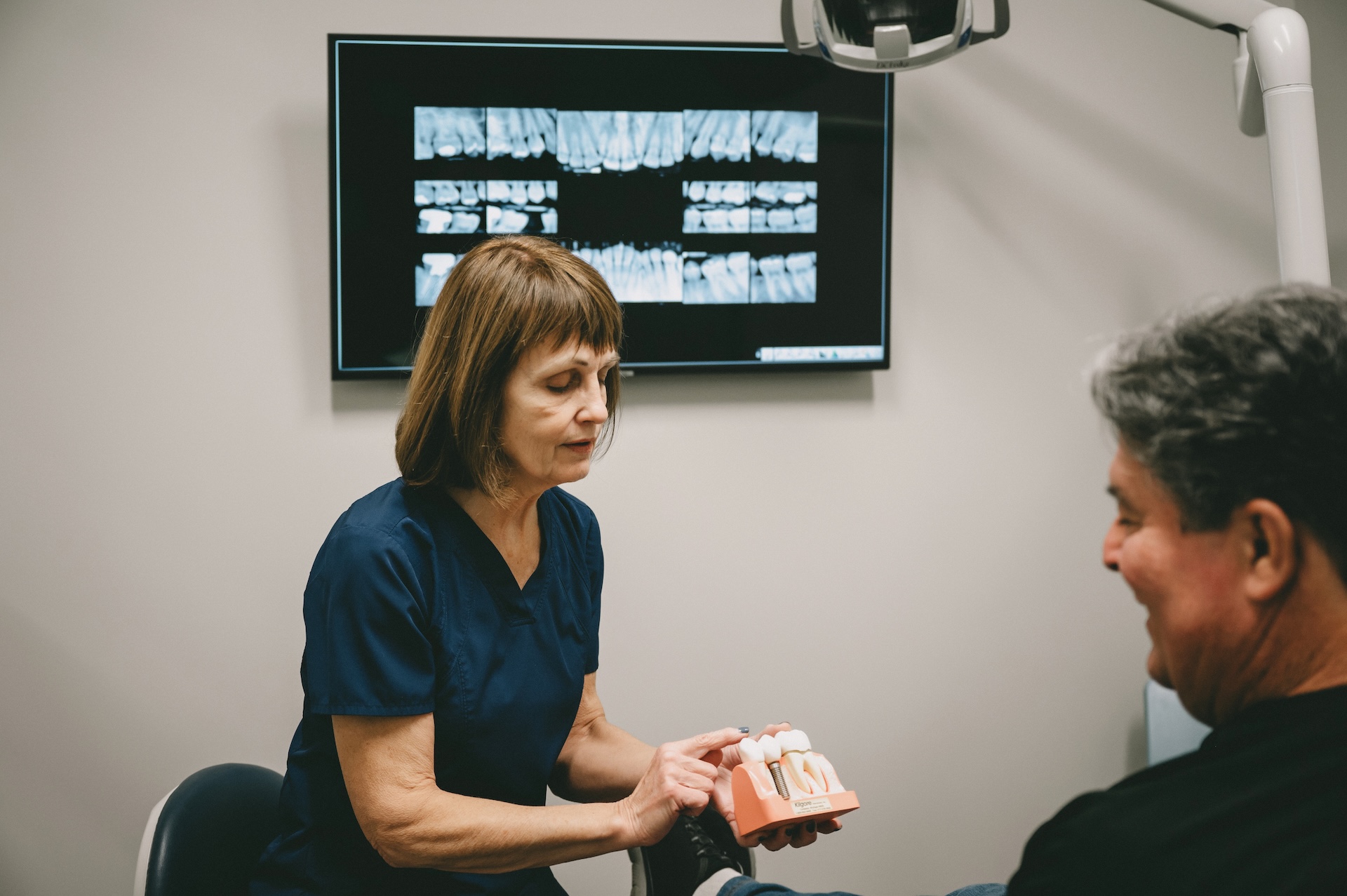
Whether you’re missing one tooth, a couple of teeth, or most of your teeth, a set of dentures from Dr. Michael Pappas and the dentists at Walnut Creek Dental may be right for you. At our office, we use the latest digital design techniques, 3D scans, and decades of combined expertise to create natural, comfortable, and realistic dentures.
Still, you may have questions about getting dentures at our Groveport, OH office. After all, we offer a variety of different options including partials, complete dentures, implant-supported dentures, and even temporaries to keep you smiling after tooth extraction. So in this guide, we’ll break down what you need to know about all of your different options for tooth replacement with dentures.
Dentures are the oldest and most well-known option for replacing missing teeth. In fact, dentures made of gold and animal teeth were used as early as 700 B.C by the Etruscan people of Italy.
Dentures consist of one or more false teeth, which are usually made out of either acrylic resin or porcelain. These teeth attach to a base that fits over your gums, your remaining teeth, or even attaches to a set of dental implants.
In turn, this base holds the false teeth in place, filling the gap in your smile and restoring your appearance. More than that, though, dentures also restore the natural function of your teeth. You’ll be able to chew and eat all of your favorite foods, speak clearly without worrying about slurring your words, and prevent further complications like teeth shifting after tooth loss.
And though their history may go back centuries, today’s dentures are far from old-fashioned. Thanks to advances in digital smile design, 3D oral scanning, and material science, today’s dentures are more flexible, comfortable, and lifelike than ever. This is especially true when you see an expert like Dr. Pappas or one of the other dentists at Walnut Creek Dental.
Wondering why you should restore your smile with a set of dentures in Groveport, OH from our team? Here are a few of the reasons why replacing missing teeth with partial or full dentures is so important.
Now that you know a little bit about dentures and their benefits, it’s time to discuss your options for restoring your smile at Walnut Creek Dental. From patients with just a few missing teeth to full-mouth restorations, we offer a wide variety of dentures that can fit into your lifestyle, schedule, and budget.
As the name suggests, partial dentures are used to replace one or more missing teeth. They are the preferred option when you still have some healthy natural teeth remaining. This is because partial dentures use a metal and/or plastic framework that clips onto your natural teeth.
This framework holds one or more false teeth in place, restoring the overall shape, function, and appearance of your smile. Partial dentures are sometimes used temporarily, but high-quality models are a viable long-term alternative to dental bridges and dental implants, especially for patients who may be on a tight budget.
Complete dentures, also sometimes called “full” dentures, are used to replace the upper, lower, or both rows (arches) of teeth. They are only recommended for patients who have extensive tooth loss or lots of damaged teeth. This is because complete dentures replace all of your teeth and require any remaining teeth to be extracted before they can be fitted and placed.
This type of denture uses a gum-colored acrylic base that fits tightly over your gums, and supports a full set of upper, lower, or both arches of teeth. If you have extensive oral health issues and need a fast, cost-effective way to restore your smile, complete dentures are usually the best choice.
Implant-supported dentures blend the stability of dental implants with the whole-mouth restoration of complete dentures. Similar to complete dentures, this treatment replaces the entire upper, lower, or both arches of teeth.
But unlike traditional dentures, implant-supported dentures don’t just fit over your gums. They attach to a set of 4-6 dental implants. These implants are surgically inserted into your jawbone, where they heal and bond permanently with the bone structure. Dentures supported by implants provide unbeatable stability and a more natural, lifelike look and feel.
Depending on the treatment technique that’s used, a set of implant-supported dentures may be removable by patients at home, or may be permanently fixed in place and only removable by a dentist. Each type has its own pros and cons, so it’s important to discuss your options with your dentist at Walnut Creek Dental.
Immediate and temporary dentures are usually used to replace a set of teeth immediately after tooth extraction, or an implant-supported denture treatment like All-On-4. They are pre-fitted so that they can be placed immediately and restore your smile right away.
These teeth let you smile and chew while your mouth heals from tooth extraction or dental implants. However, temporary dentures are not usually as comfortable, long-lasting, or as durable as permanent dentures.
This means you’ll need to follow some special care steps to keep them in good shape as you heal and recover. And once your mouth has healed from your surgery, you’ll be able to come back to Walnut Creek Dental to be fitted for your permanent set of teeth.
Complete dentures are meant to stay in place by fitting tightly over your gums, and partial dentures fit over your gums and attach to healthy teeth with a metal framework. With a properly-fitted, high-quality set of dentures from Walnut Creek Dental, your teeth will typically be held tightly in place by friction, and there will be no need for any other products.
However, denture adhesive can still be useful in some cases. For example, if you know you’ll be eating lots of hard-to-chew foods or you want to make sure your teeth don’t shift at all during a big meeting or public speaking event, adhesives give you a little bit more peace of mind.
Denture adhesives are specially designed, non-toxic products that are meant to help your dentures hold onto your gums and teeth more strongly. This enhances overall denture stability and comfort.
The biggest drawback of using denture adhesives is that they require a bit more effort to clean off of your dentures and your gums at the end of the day. Still, they are definitely worth using if you need a little bit more support and want to make sure your dentures stay tightly fixed in place.
There are hundreds of denture adhesive products available from dozens of different brands. Not sure which one is right for you? There are minor differences between each product, of course, but denture adhesives usually fall into one of the following three categories.
If you’re exploring multiple options for tooth replacement in Groveport, OH, you may be wondering if you should choose dentures or dental implants. After all, both procedures can restore the natural beauty of your smile and the natural function of your teeth.
While it’s best to consult with a dentist to choose the right option for your unique needs, it can still be helpful to know the differences between each treatment. So in this section of our guide, we’ll take a quick look at the pros and cons of dentures vs. implants.
Still not sure if you should choose to restore your smile with a set of dentures, or if a treatment like single-tooth implants, implant-supported bridges, or implant dentures may be a better option? Here’s a quick overview of what treatment might be right for you.
Deciding between dentures and dental implants is a big decision, which is why it’s best to consult with an experienced dentist at Walnut Creek Dental. During your visit to our office, your dentist can break down the pros and cons of each option, discuss costs and financing, and help you make the right choice for your lifestyle and oral health.
At Walnut Creek Dental, Dr. Pappas and our team of dentists specialize in restorative dentistry. Whether you’re interested in dentures in Groveport, OH or you’d like to explore other options like dental bridges or dental implants, our team is here to help. We offer expert advice, transparent pricing, and honest input on the best option for both your short-term and long-term oral health.
So don’t wait. If you’re ready to replace your missing teeth and start smiling proudly again, we’re just a click or a call away. Get in touch now at (614) 864-2466 or contact us online to schedule a consultation at Walnut Creek Dental and take the first steps toward a brighter, healthier, and more functional smile.
Call 614-864-2466 or request an appointment online to set up your first visit. We’ll be in touch soon.